
Slam Mapping Navigation Omnidirectional Mobile Robot: Chuangwang Drive-by-Wire Chassis, Ros1 Open-Source Compatible
In the era of intelligent manufacturing and automated service, mobile robots have become core equipment supporting the transformation of industries such as logistics, warehousing, and intelligent services. Among them, omnidirectional mobile robots equipped with SLAM (Simultaneous Localization and Mapping) mapping and navigation capabilities stand out due to their flexible movement and autonomous operation advantages. The integration of high-performance drive-by-wire chassis and open-source compatibility further unlocks their application potential. This article focuses on the integrated solution of SLAM mapping navigation omnidirectional mobile robots, with a special emphasis on the core support of the Chuangwang drive-by-wire chassis and the technical value of ROS1 open-source compatibility.
The Core Demand: SLAM Mapping Navigation and Omnidirectional Mobility
For mobile robots operating in complex and dynamic environments, autonomous positioning, real-time mapping, and flexible movement are three core requirements that determine their operational efficiency and adaptability. SLAM technology, as the "eyes and brain" of autonomous mobile robots, solves the key problem of constructing or updating environmental maps while simultaneously tracking the robot’s own position in unknown environments—a classic "chicken-and-egg" problem that has been effectively addressed through algorithms such as particle filters and graph SLAM. This technology enables robots to independently explore unknown spaces, collect environmental feature data through sensors (such as lidar), and generate high-precision maps in real time, laying a foundation for path planning and obstacle avoidance.
Omnidirectional mobility, as a complement to SLAM navigation, breaks the movement limitations of traditional differential-drive robots. Unlike conventional robots that require turning to adjust direction, omnidirectional mobile robots can achieve transverse movement, in-situ rotation, and arbitrary trajectory movement, which is particularly critical for narrow spaces (such as warehouse aisles) and scenarios requiring frequent direction changes (such as office reception and supermarket delivery). The combination of SLAM mapping navigation and omnidirectional mobility enables robots to adapt to diverse complex scenarios, improving operational flexibility and efficiency.
Chuangwang Drive-by-Wire Chassis: The Reliable Foundation for High-Performance Movement
The chassis is the "feet" of a mobile robot, and its performance directly determines the robot’s movement accuracy, stability, and load capacity. The Chuangwang drive-by-wire chassis, as a high-quality core component tailored for omnidirectional mobile robots, has become the preferred choice for many intelligent robot projects due to its excellent control performance and structural design.
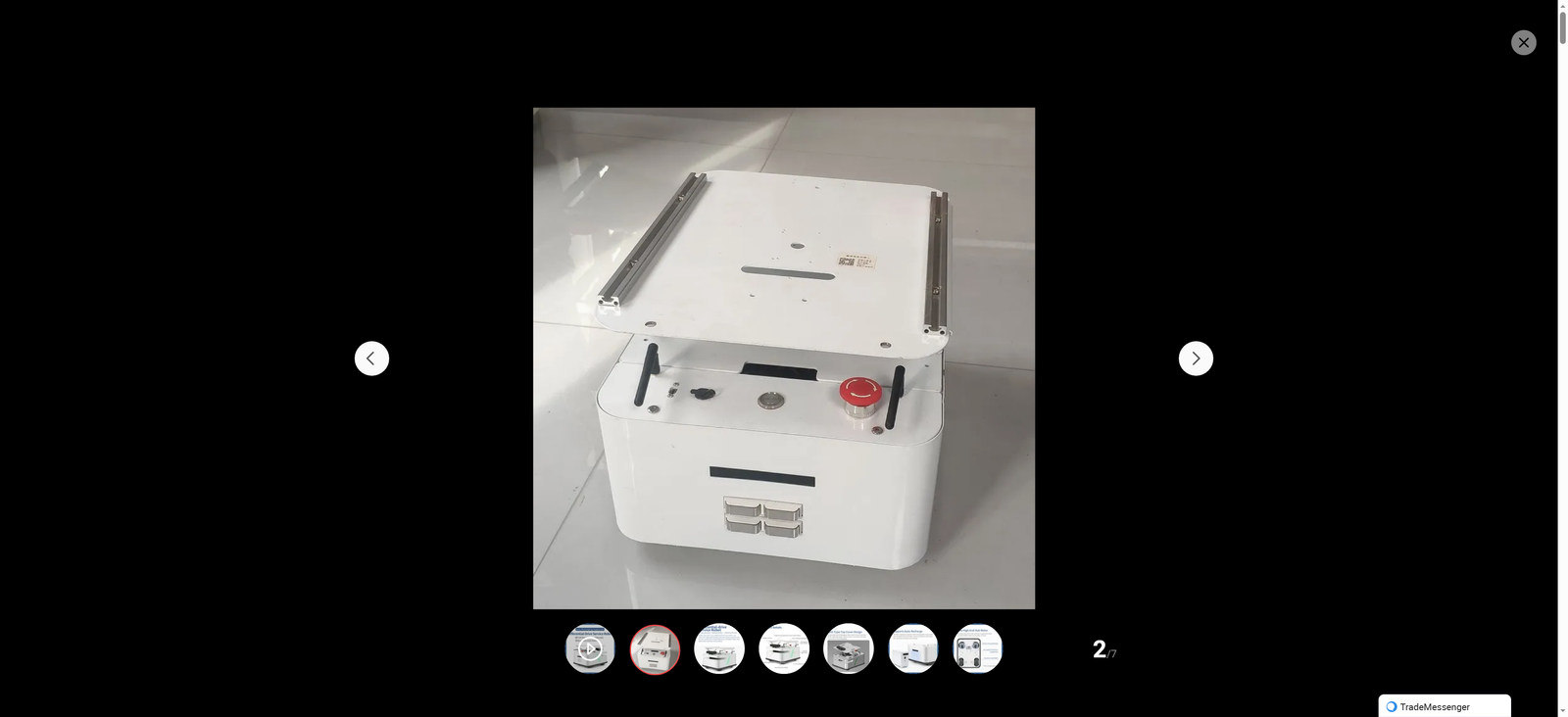
Drive-by-wire technology, which replaces mechanical connections with electrical signals to achieve precise control of the robot, is the core advantage of the Chuangwang chassis. Different from traditional mechanical chassis, the Chuangwang drive-by-wire chassis realizes decoupling of human-machine control, integrating wire-controlled drive, wire-controlled steering, and wire-controlled braking systems to achieve fast response and high-precision control. Its steering angle control accuracy can reach ≤1°, and the brake fluid pressure control accuracy is ≤1 bar, ensuring that the robot can accurately execute movement commands even in high-precision operation scenarios. Meanwhile, the chassis adopts a modular design with a compact structure, and its standardized size (such as 540x360x355mm for small models) is compatible with various upper-mounted devices (such as lidar, cameras, and robotic arms), meeting the customization needs of different application scenarios.
In terms of adaptability, the Chuangwang drive-by-wire chassis has excellent environmental adaptability. It supports a certain load capacity, can operate stably on uneven ground, and has good performance in wading and climbing, making it suitable for both indoor scenarios (such as home cleaning, hotel room service) and outdoor semi-structured environments. In addition, the chassis is equipped with an open SDK for secondary development, allowing developers to adjust parameters and optimize control algorithms according to specific project needs, further expanding its application scope.
ROS1 Open-Source Compatible: Lowering the Threshold for Intelligent Development
In the field of mobile robot development, open-source ecosystems play a crucial role in accelerating technological iteration and reducing development costs. ROS (Robot Operating System), as a mature open-source robot development framework, provides a complete set of tools, libraries, and communication mechanisms for robot development, enabling developers to focus on core functional development without repeating the construction of basic systems. The SLAM mapping navigation omnidirectional mobile robot based on the Chuangwang drive-by-wire chassis is fully compatible with ROS1, which is a key advantage in its technical layout.
ROS1 compatibility means that the robot can seamlessly integrate with a large number of open-source resources in the ROS1 ecosystem. For SLAM mapping and navigation functions, developers can directly use mature open-source algorithms (such as GMapping, Cartographer) and sensor drivers, avoiding the tedious process of independent development and debugging of algorithms. For example, by combining lidar sensors with ROS1-compatible drivers, the robot can quickly realize real-time point cloud data collection and SLAM map construction, and optimize map accuracy through loop detection and backend error correction mechanisms in the ROS1 framework.
In addition, ROS1 provides a standardized communication interface for the Chuangwang drive-by-wire chassis, enabling seamless connection between the chassis control system and the robot’s upper-layer intelligent modules (such as SLAM mapping, path planning, and task scheduling). Developers can easily call the control interface of the Chuangwang drive-by-wire chassis through ROS1 nodes to realize precise control of omnidirectional movement, such as adjusting movement speed, direction, and rotation angle in real time. At the same time, ROS1 supports simulation tools such as Gazebo, allowing developers to conduct virtual simulation tests of the robot’s SLAM mapping, navigation, and chassis movement before physical deployment, reducing development risks and test costs.
The open-source nature of ROS1 also promotes the sharing and iteration of technical solutions. Developers can share their optimized code and application cases based on the Chuangwang drive-by-wire chassis and ROS1, forming a mutually beneficial development ecosystem. For small and medium-sized enterprises and research institutions with limited R&D resources, ROS1 compatibility significantly lowers the threshold for developing SLAM omnidirectional mobile robots, enabling them to quickly launch customized products and applications.
Integrated Application: Creating a New Paradigm for Intelligent Robots
The integration of SLAM mapping navigation, Chuangwang drive-by-wire chassis, and ROS1 open-source compatibility has created a high-performance, low-threshold omnidirectional mobile robot solution, which has been widely applied in various fields. In the field of intelligent warehousing, the robot can use SLAM technology to quickly map the warehouse environment, realize autonomous navigation and goods handling, and rely on the omnidirectional movement capability of the Chuangwang chassis to flexibly shuttle between narrow aisles, improving warehousing efficiency. In the field of commercial services, the robot can be used as a receptionist, delivery robot, or cleaning robot, completing tasks such as guiding visitors, delivering goods, and cleaning in hotels, offices, and supermarkets, with the Chuangwang chassis ensuring stable and quiet operation and ROS1 enabling rapid functional customization.
In the field of scientific research and education, this integrated solution provides a reliable experimental platform for researchers and students. Researchers can conduct in-depth research on SLAM algorithm optimization, omnidirectional movement control, and ROS1-based system integration based on this platform; students can quickly master the core technologies of intelligent mobile robots through practical operations, cultivating practical R&D capabilities. In addition, in special scenarios such as industrial inspection and medical logistics, the robot can rely on its high-precision SLAM mapping navigation and stable chassis performance to complete tasks that are difficult for humans, improving work safety and efficiency.
Conclusion
SLAM mapping navigation technology endows omnidirectional mobile robots with autonomous intelligence, the Chuangwang drive-by-wire chassis provides a reliable and high-performance movement foundation, and ROS1 open-source compatibility lowers the development threshold and accelerates technological iteration. The organic combination of these three elements has promoted the upgrading of omnidirectional mobile robots from "semi-autonomous" to "full-autonomous", and from "single-scenario application" to "multi-scenario adaptation".
With the continuous development of intelligent manufacturing and service automation, the demand for high-performance, low-cost autonomous mobile robots will continue to grow. The SLAM mapping navigation omnidirectional mobile robot based on the Chuangwang drive-by-wire chassis and ROS1 open-source compatibility will surely play a more important role in various industries, promoting the deep integration of intelligent technology and production and life, and creating greater value for social development.