
Intelligent Multifunction Restaurant Robots: Redefining the Future of Catering Services
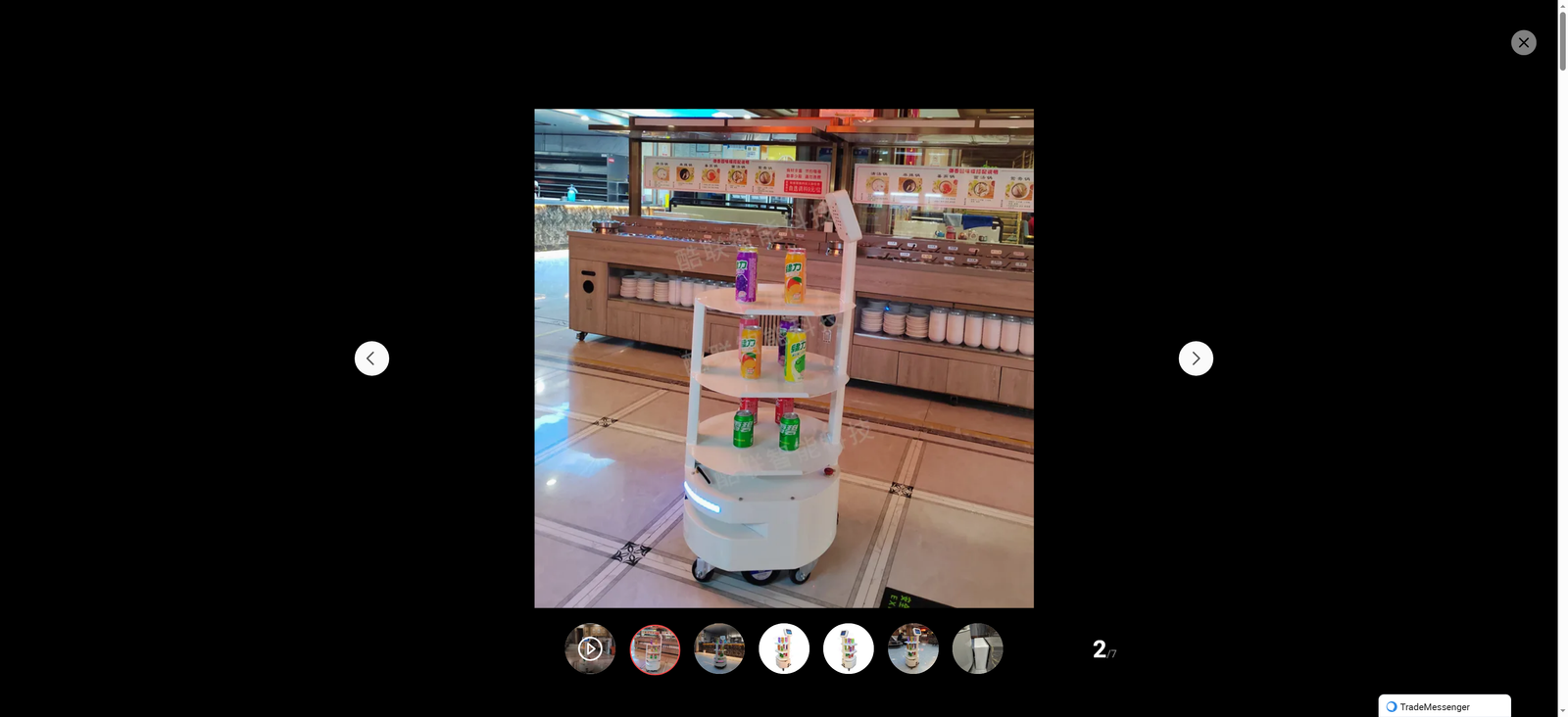
In the wave of global intelligent transformation, the catering industry is undergoing a profound revolution driven by technology. As a core driving force, intelligent multifunction restaurant robots, including robot waiters and automated food delivery robots, have broken the bottlenecks of traditional catering operations. Professional manufacturers, with their technological accumulation and innovative capabilities, are continuously optimizing these intelligent devices, making them an indispensable part of modern catering services and reshaping the industry's development pattern.
The rise of intelligent restaurant robots is not accidental but a result of the joint action of policy guidance, market demand and technological progress. Globally, "intelligent manufacturing" and "smart services" have become the core directions of industrial upgrading. In China, the "14th Five-Year Plan for Robot Industry Development" clearly promotes the large-scale application of service robots in the catering field, with special funds and tax incentives to reduce the threshold for enterprises to adopt intelligent equipment . Meanwhile, the catering industry is facing dual pressures of rising labor costs (accounting for 30%-40% of operating costs in 2023) and upgrading consumer demand. The Z generation, which will account for 40% of the consumer market by 2025, has a strong demand for technological and interactive dining experiences, and 68% of consumers are willing to pay a 15%-20% premium for robot services . Against this backdrop, professional manufacturers have accelerated the R&D and production of multifunction restaurant robots, turning technological advantages into practical solutions for the industry.
A professional manufacturer of intelligent restaurant robots focuses on integrating multiple functions and intelligent technologies to create a full-scenario service ecosystem. Unlike single-function devices, modern restaurant robot waiters and automated food delivery robots are integrated with AI visual recognition, voice interaction, SLAM path planning and IoT scheduling technologies, realizing a closed-loop service covering greeting, ordering, food delivery, table cleaning and dish recycling . The perception layer, composed of lidar, depth cameras and ultrasonic sensors, acts as the "eyes and ears" of the robot, enabling it to achieve centimeter-level positioning, accurately identify obstacles and complete dish recognition . The decision-making layer, as the "brain", can plan optimal routes in real time, dynamically avoid moving customers and chairs, and realize collaborative work of multiple robots through the central scheduling system . The execution layer ensures stable food delivery with anti-spill structures and flexible chassis, while supporting voice broadcasts and touch-screen interactions to enhance the customer experience .
These intelligent multifunction robots have shown remarkable value in diverse catering scenarios, supported by professional manufacturers' customized capabilities. In fast-food chains with standardized processes, 5-10 automated food delivery robots can operate simultaneously, improving delivery efficiency by 30% and reducing labor costs by 25% . In high-end catering venues, robot waiters integrate personalized service functions, such as remembering customer dietary preferences and providing multilingual explanations, adding a sense of technology to the premium dining experience . In theme restaurants and campuses, multifunction robots can not only deliver meals but also make coffee, pancakes and other foods—for example, AI coffee robots can complete a cup of coffee in 90 seconds, while pancake robots can produce 200 portions a day with standardized craftsmanship . Some advanced solutions even realize "air rail delivery automatic plate recycling contactless payment" full-process automation, creating a seamless dining experience for 24-hour operation scenarios such as science and technology parks .
The global market for intelligent restaurant robots is booming, with professional manufacturers leading the industrial upgrading. In 2024, the global intelligent service robot market reached 18 billion US dollars, with catering service robots accounting for 25% and becoming the fastest-growing segment . The Asia-Pacific region leads the world with 150,000 units deployed, and China, as the largest market, achieved a scale of 42 billion yuan in 2024, with a penetration rate of 12% in the catering industry . International manufacturers such as KUKA have launched fully automated sushi restaurants in Barcelona, integrating robotic arms for food preparation and mobile robots for table service to create an immersive dining experience . Domestic manufacturers are also accelerating technological iteration, improving AI recognition accuracy to 98%, reducing robot prices by 20% through large-scale production, and expanding the market to second and third-tier cities .
Looking ahead, with the deep integration of AI large models, 5G and IoT technologies, professional manufacturers will continue to promote the evolution of multifunction restaurant robots. In the near future, these robots will have stronger emotional interaction capabilities, be able to understand complex customer needs and provide personalized recommendations . In the medium and long term, the combination of autonomous operation systems and augmented reality technology will realize more innovative service forms, such as projecting interactive menus through robots . As technology matures and costs decrease, intelligent multifunction restaurant robots will no longer be a "novelty" but a standard configuration in the catering industry, helping more catering enterprises achieve efficient, safe and high-quality operations.
In conclusion, intelligent multifunction restaurant robots represented by robot waiters and automated food delivery robots are leading the catering industry into a new era of intelligence. Professional manufacturers, with their technological innovation capabilities and scenario-based solutions, are breaking through the limitations of traditional services, balancing operational efficiency and customer experience. As policy support, market demand and technological progress form a synergy, these intelligent robots will continue to release industrial value, writing a new chapter for the high-quality development of the global catering industry.