
Intelligent Disinfection Robot: A High-Tech Guardian for Air and Environment in Public Spaces
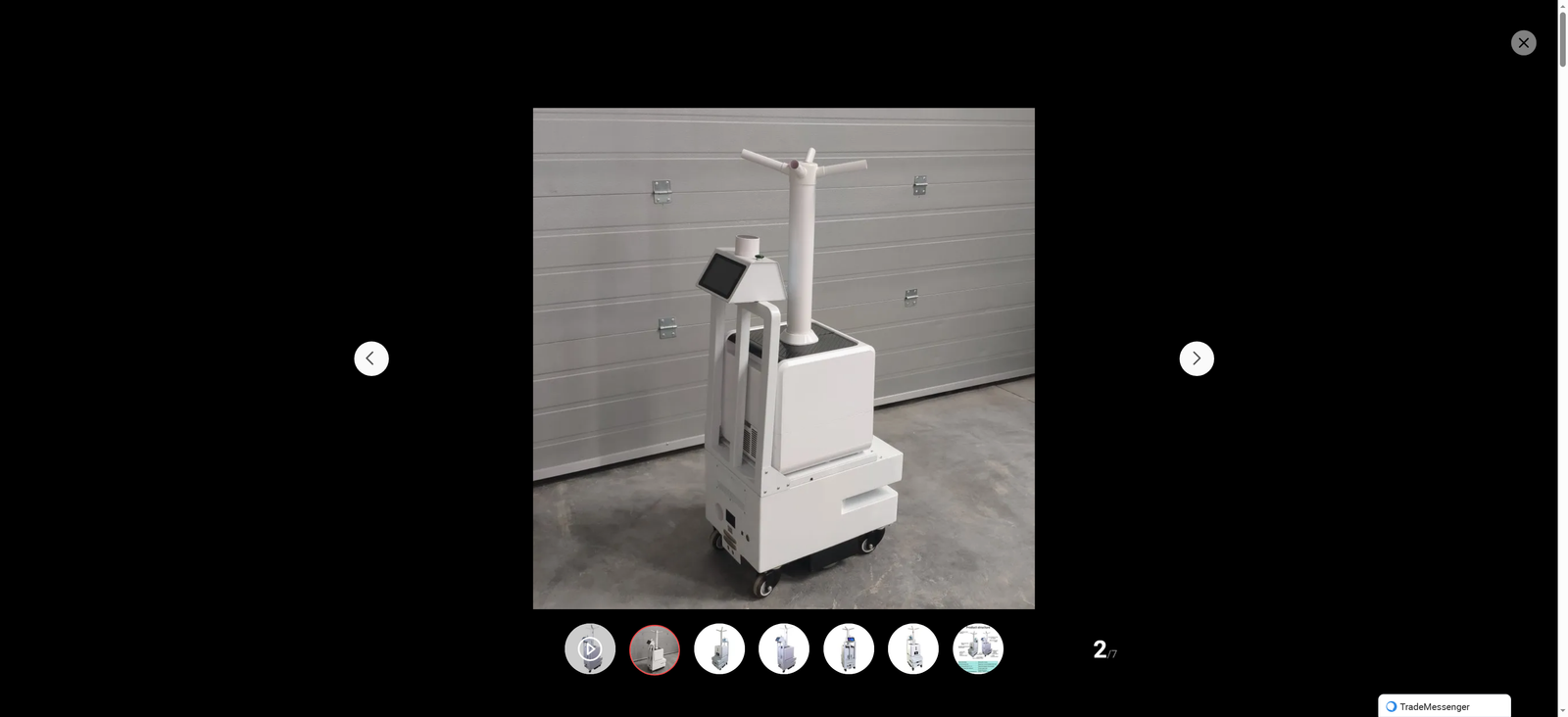
In the context of increasing attention to public health and epidemic prevention, traditional manual disinfection methods are gradually unable to meet the needs of high efficiency, thoroughness and safety in public spaces. The emergence of intelligent disinfection robots, with their high-tech fully automatic design and efficient anti-epidemic spraying disinfection capabilities, has become a new benchmark for environmental sanitization in places such as exhibition halls and schools, providing a reliable barrier for air and surface disinfection.
The core advantage of intelligent disinfection robots lies in their high-tech fully automatic design, which breaks the limitations of manual operation. Equipped with advanced navigation systems such as laser SLAM and visual V-SLAM fusion technology, these robots can independently build maps of the environment, plan optimal disinfection routes, and achieve 360-degree non-dead-angle coverage without human intervention . They are equipped with dual anti-collision protection mechanisms of obstacle detection sensors and mechanical anti-collision structures, which can flexibly avoid pedestrians, exhibits and teaching equipment during operation, ensuring safe and stable work in crowded or complex spaces . In addition, the fully automatic control system supports remote map construction, task deployment and real-time data monitoring. Managers can set disinfection time, intensity and routes through the background, and view working status and disinfection records in real time, realizing quantitative management of disinfection work . When the power is low, the robot can automatically return to the charging station for charging, achieving 24/7 continuous work capability and greatly improving the efficiency of disinfection operations.
In terms of anti-epidemic spraying disinfection and sterilization, intelligent disinfection robots adopt efficient and safe technical solutions to comprehensively purify air and surfaces. Most robots use pure molecular chlorine dioxide as the disinfectant, which can actively capture harmful microorganisms in the air, inactivate bacteria, viruses and other pathogens through oxidation, with a disinfection rate of up to 93.86% and an ammonia removal rate of 98% . The advanced atomization system can convert the disinfectant into tiny particles of less than 10μm, which can float in the air for a long time and fully contact with air pollutants, effectively eliminating aerosol-borne pathogens . Some high-performance models also integrate multiple disinfection methods such as plasma, ultraviolet irradiation and spray disinfection, forming a multi-dimensional disinfection network to ensure thorough sterilization of both air and object surfaces . The disinfectant used is non-toxic and harmless, and its final products are carbon dioxide and water, avoiding secondary pollution to the environment and ensuring the safety of personnel in the space .
Exhibition halls and schools, as typical public spaces with large passenger flow and high mobility, have an urgent need for efficient disinfection solutions, and intelligent disinfection robots are highly suitable for these scenarios. For exhibition halls, which often have large spaces, complex layouts and frequent flow of people and exhibits, traditional manual disinfection is difficult to cover all areas in a timely manner and may affect the visiting experience. Intelligent disinfection robots can flexibly shuttle through exhibition areas, corridors and rest zones according to preset routes, and complete large-area disinfection work efficiently during the interval between exhibitions or after closing . Their low noise design (only 45dB) will not disturb the normal visiting order, and the compact body can easily pass through narrow passages between exhibits . For schools, classrooms, auditoriums, canteens and other areas have dense crowds of students, and the risk of cross-infection is relatively high. The robot can carry out timed and cyclical disinfection during non-teaching hours such as early morning, noon break and evening . It takes only 100 minutes to complete the full disinfection of a 1,000-square-meter area, which is 10 times more efficient than traditional manual disinfection, and can effectively kill 99.99% of spores and drug-resistant bacteria on surfaces . In addition, the robot can automatically take elevators to achieve cross-floor disinfection, fully covering the entire campus space .
With the continuous advancement of intelligent technology, the market scale of intelligent disinfection robots is expanding rapidly. It is predicted that the global market size will grow to 76.834 billion yuan by 2030, with a compound annual growth rate of 18.36% . In the future, these robots will be further upgraded in terms of intelligent decision-making, energy management and scenario adaptation. They will be able to automatically optimize disinfection plans based on big data analysis, adapt to more special environments, and extend battery life to provide longer continuous work . As a high-tech product integrating automation, intelligence and environmental protection, intelligent disinfection robots are not only an important tool for epidemic prevention and control, but also a key part of building a healthy and safe public space environment. They are quietly guarding the air quality and health of people in exhibition halls, schools and other places, injecting strong power into the modernization of public health management.