
Laser Navigation Delivery Robots: Redefining Intelligent Service with Mobile Innovation
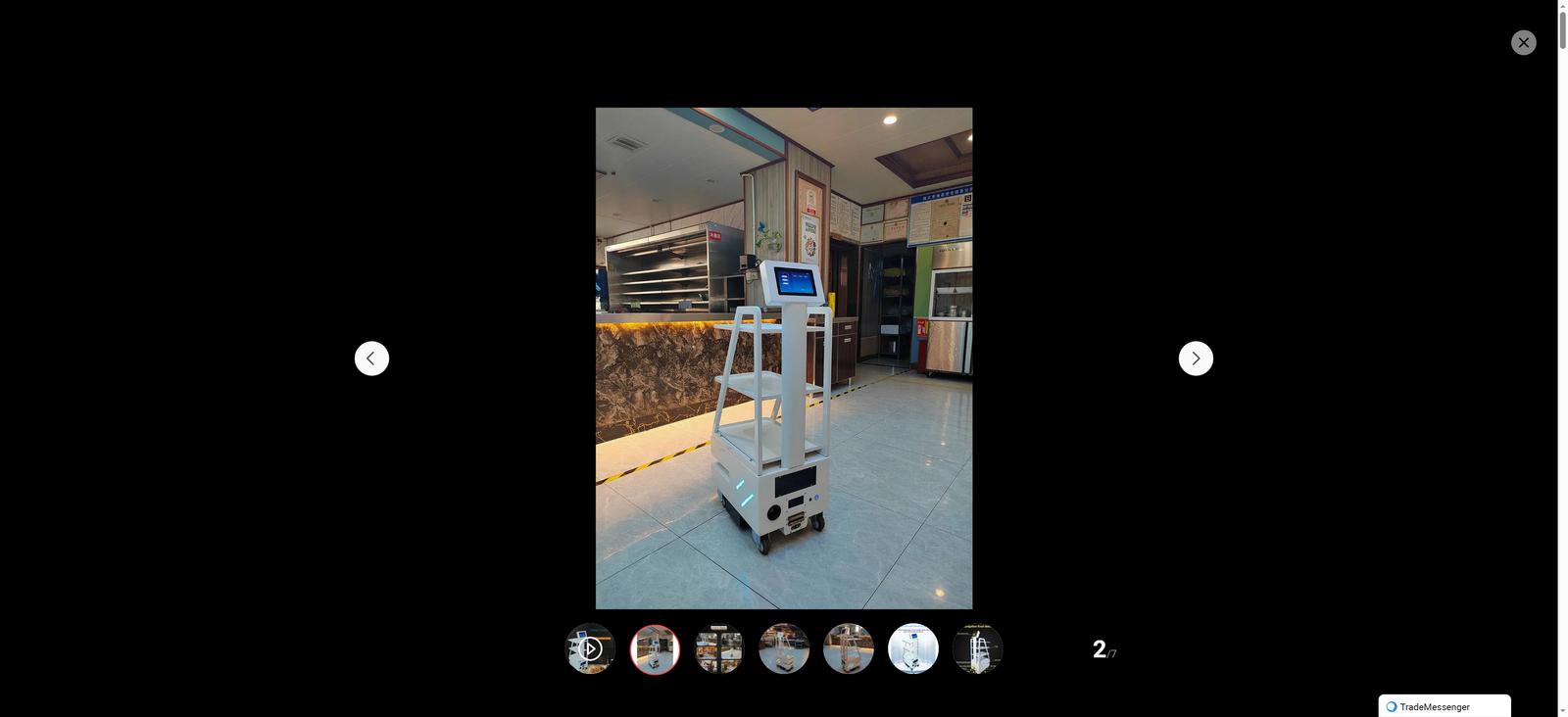
In the wave of the global intelligent manufacturing and service industry upgrading, laser navigation delivery robots have emerged as a pivotal force integrating intelligent service robot, mobile robot, and service waiter functionalities. Driven by cutting-edge technologies such as lidar and embodied intelligence, these robots are breaking the boundaries of traditional manual services, injecting new vitality into industries like catering, logistics, and healthcare with high precision, efficiency, and flexibility.
The Core Driving Force: Laser Navigation Technology
At the heart of laser navigation delivery robots lies lidar (Light Detection and Ranging) technology, a core component that distinguishes them from conventional mobile robots. The working principle of lidar is based on emitting laser pulses and calculating the time difference or frequency change of the reflected signals to accurately measure the distance and position of objects. Equipped with laser transmitters, high-sensitivity detectors, and advanced data processing units, these robots can quickly construct three-dimensional point cloud maps of the environment, achieving centimeter-level positioning accuracy through real-time signal analysis and processing.
Unlike single-sensor navigation systems, modern laser navigation delivery robots adopt a multi-sensor fusion strategy, combining lidar with visual cameras, inertial measurement units (IMUs), and ultrasonic sensors. This integration not only enhances environmental perception capabilities but also improves anti-interference performance, enabling stable operation even in complex scenarios such as dimly lit restaurants, crowded shopping malls, or dynamically changing warehouses. With the support of SLAM (Simultaneous Localization and Mapping) algorithms, the robots can dynamically update environmental maps, adjust movement trajectories in real-time, and realize autonomous path planning and adaptive obstacle avoidance—effectively solving the pain points of traditional service robots that rely on preset tracks or are prone to misjudgment.
Multi-Scenario Application: From Service Waiter to All-Round Assistant
As a new type of service waiter, laser navigation delivery robots have been widely applied in the catering industry, reshaping the service process. In smart restaurants such as Haidilao and JD X Future Restaurant, after customers place orders via tablets, the robots automatically receive tasks from the background system, navigate through crowded dining areas to the kitchen, pick up dishes, and deliver them accurately to the designated tables. Equipped with intelligent voice interaction modules, they can politely remind pedestrians to make way with phrases like "Could you please move aside?" and dynamically adjust their speed and route to avoid collisions. These robots can work 24 hours a day without fatigue, reducing the labor burden of waiters by over 40% and shortening the average food delivery time to less than 10 minutes, significantly improving service efficiency and customer experience.
Beyond the catering sector, these intelligent service robots are exerting their strengths in logistics, healthcare, and other fields. In warehousing and logistics, they collaborate with sorting systems to autonomously transport goods between different functional areas, reducing the time for goods turnover by 30% and improving the overall operational efficiency of warehouses. In medical institutions, laser navigation delivery robots undertake the transportation of drugs, inspection samples, and medical supplies, minimizing the risk of cross-infection caused by manual delivery and ensuring the timeliness of emergency supplies. In scenarios such as hotels and office buildings, they also serve as reliable mobile assistants, delivering room service items, documents, and packages, freeing human resources from repetitive and tedious tasks.
Industry Value and Development Trends
The large-scale application of laser navigation delivery robots aligns with the global trend of industrial intelligence and labor cost optimization. With the continuous rise of labor costs in service industries, these robots can help enterprises reduce long-term operational costs while maintaining stable service quality through 24-hour uninterrupted work and low maintenance requirements. According to predictions from the International Federation of Robotics (IFR), the global service robot market will reach 150 billion US dollars in 2026, with laser navigation robots as a key growth driver, boasting a compound annual growth rate exceeding 35%.
Looking ahead, the development of laser navigation delivery robots will focus on three directions. Technically, the integration of lidar with 5G, edge computing, and deep learning will further enhance their environmental adaptability and decision-making capabilities, enabling more precise fine operations and safer human-machine collaboration. In terms of functionality, modular design will become mainstream, allowing robots to be quickly adapted to different scenarios such as cold chain transportation and high-risk environment operations by replacing functional modules. Ecologically, the construction of a "platform application" industrial ecosystem will accelerate, with cloud scheduling systems realizing efficient collaboration among multiple robots and third-party developers continuously enriching robot application scenarios.
From being a simple mobile robot to a comprehensive intelligent service provider, laser navigation delivery robots are not only changing the way services are delivered but also promoting the transformation and upgrading of traditional industries. As core carriers of embodied intelligence, they will play an increasingly important role in building smart cities and a sustainable development society, bringing a more convenient and efficient life experience to people.