
The New Era of Hotel Cleaning: Autonomous Disinfectant Robots Leading Technological Innovation in Sanitation
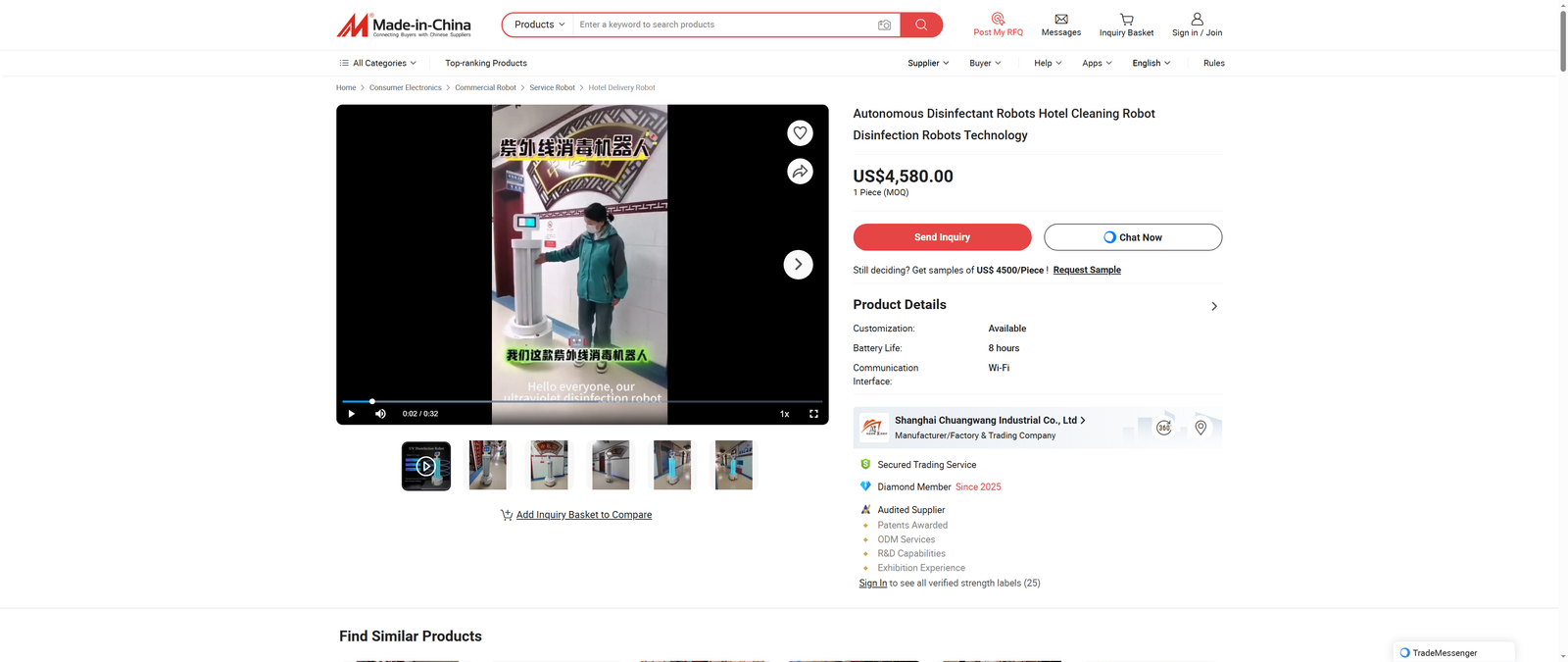
In the post-pandemic era, the pursuit of health and safety has become a core demand for hotel guests, and the standard of hotel cleaning and disinfection has been raised to an unprecedented height. Traditional manual cleaning and disinfection methods are not only limited by factors such as labor intensity, human error, and uneven standards but also difficult to meet the high-frequency, high-precision, and full-coverage disinfection needs of modern hotels. Against this background, autonomous disinfectant robots, as a key product integrating hotel cleaning robot technology and professional disinfection technology, have gradually become a new benchmark for hotel sanitation management, injecting strong momentum into the intelligent transformation of the hotel industry.
Autonomous disinfectant robots are not a simple combination of "robot disinfectant", but a high-tech device that integrates multiple cutting-edge technologies such as autonomous navigation, environmental perception, precision spray control, and intelligent operation and maintenance. Compared with traditional hotel cleaning robots that only focus on sweeping and mopping, autonomous disinfectant robots focus more on the core demand of "disinfection and sterilization", and have realized a leap from "cleaning" to "sanitizing", effectively solving the pain points of manual disinfection such as incomplete coverage, uncontrollable concentration, and potential cross-contamination.
The core competitiveness of autonomous disinfectant robots lies in their advanced technological support. In terms of autonomous navigation technology, most products adopt a multi-sensor fusion scheme, including laser radar, visual cameras, ultrasonic sensors, etc., which can accurately map the hotel's indoor environment, identify obstacles such as furniture, equipment, and pedestrians in real time, and plan the optimal disinfection path autonomously. Whether it is a spacious lobby, a narrow corridor, a standard guest room, or a public area such as a restaurant and elevator, the robot can flexibly navigate and avoid obstacles, ensuring that every corner is covered without missing or repeating. This not only greatly improves the efficiency of disinfection but also avoids the interference of human factors on the disinfection effect.
In terms of disinfection technology, autonomous disinfectant robots adopt a variety of professional disinfection methods according to the different needs of hotel scenarios, forming a multi-dimensional disinfection system. Common technologies include ultraviolet (UV-C) disinfection, atomized disinfectant spray, and electrostatic spray disinfection. UV-C disinfection technology can effectively inactivate bacteria, viruses, and other microorganisms by emitting specific wavelengths of ultraviolet rays, with a sterilization rate of up to 99.99%; atomized spray technology can atomize the disinfectant into tiny particles, which can evenly float in the air and adhere to the surface of objects, realizing full coverage of air and surface disinfection; electrostatic spray technology makes the disinfectant particles carry static electricity, which can actively adsorb to the surface of objects, even the back of furniture and other dead corners that are not easy to reach, further improving the disinfection effect. At the same time, the robot is equipped with an intelligent concentration control system, which can automatically adjust the dosage and concentration of disinfectant according to the size of the space and the pollution level, ensuring the disinfection effect while avoiding secondary pollution caused by excessive disinfectant residues.
The application of autonomous disinfectant robots in hotels has brought a comprehensive upgrade to hotel operation and management. For hotel operators, on the one hand, it can significantly reduce labor costs. A single autonomous disinfectant robot can complete the disinfection work of multiple guest rooms or public areas in one day, which is equivalent to the workload of 2-3 manual cleaners, and can work 24 hours a day without rest, greatly improving work efficiency. On the other hand, it can standardize the disinfection process. The robot strictly executes the preset disinfection procedures and parameters, avoiding the problem of uneven disinfection quality caused by differences in manual operation skills, sense of responsibility, and other factors, and forming a traceable disinfection record, which provides a reliable basis for hotel quality supervision and safety management. For hotel guests, the appearance of autonomous disinfectant robots not only brings a more reassuring and healthy living environment but also shows the hotel's attention to health and safety and the concept of intelligent service, enhancing the guest's sense of experience and trust.
With the continuous progress of technology and the deepening of the intelligent transformation of the hotel industry, autonomous disinfectant robots are also constantly evolving and upgrading. In the future, with the integration of technologies such as 5G, the Internet of Things, and artificial intelligence, autonomous disinfectant robots will realize more intelligent functions: they can be connected to the hotel's intelligent management system to automatically receive disinfection tasks according to the check-in and check-out status of guests; they can monitor the indoor air quality and microbial content in real time, and carry out targeted disinfection when the index exceeds the standard; they can also realize mutual cooperation between multiple robots, divide work and cooperate to complete large-area disinfection tasks more efficiently. At the same time, the volume and appearance of the robot will be more compact and beautiful, better integrating with the hotel's decoration style, and reducing the sense of oppression brought to guests.
However, the popularization and application of autonomous disinfectant robots in the hotel industry still face some challenges. For example, the initial purchase cost is relatively high, which may bring certain economic pressure to small and medium-sized hotels; the maintenance and maintenance of the robot require professional technical personnel, and the professional quality of the hotel's existing staff needs to be improved; in addition, there are certain differences in the applicable scenarios and disinfection effects of different types of robots, which requires hotels to make reasonable choices according to their own actual conditions. Despite these challenges, with the continuous decline of technological costs and the gradual improvement of the industrial chain, autonomous disinfectant robots will surely become a standard configuration in the hotel industry.
In conclusion, autonomous disinfectant robots, as a perfect combination of hotel cleaning robot technology and disinfection technology, are not only a technological innovation in the field of hotel cleaning but also a concrete practice of the hotel industry's pursuit of health and safety. They are changing the traditional hotel sanitation management mode with their efficient, accurate, and intelligent advantages, and bringing new development opportunities to the hotel industry. In the future, with the continuous advancement of technology, autonomous disinfectant robots will play a more important role in promoting the intelligent, healthy, and high-quality development of the hotel industry, creating a more reassuring and comfortable living environment for guests around the world.