
High-Tech Fully Automatic Disinfection Robot: A New Benchmark for Epidemic Prevention and Sterilization in Diverse Scenarios
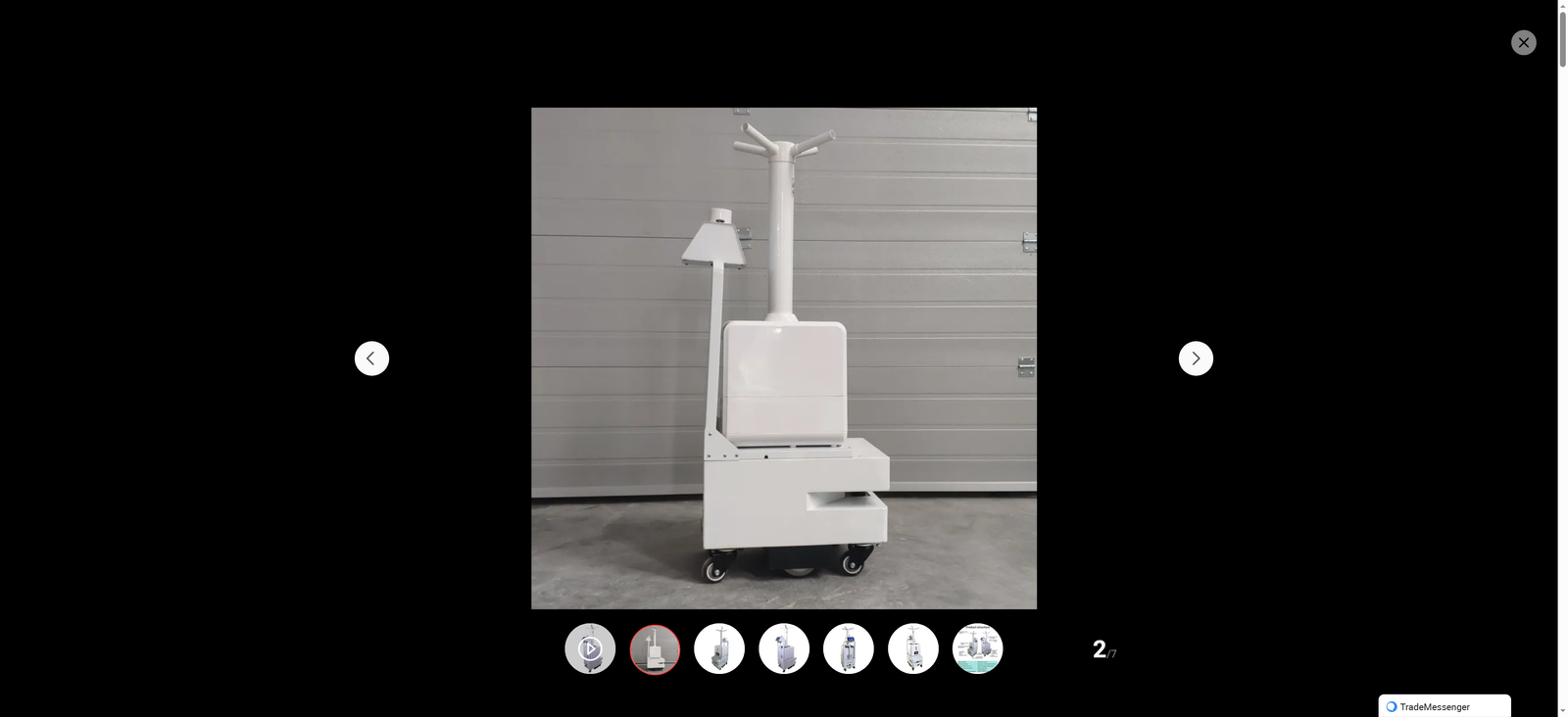
In the context of increasing attention to public health security, the demand for efficient, thorough and intelligent disinfection solutions is rising sharply across various fields. The high-tech fully automatic disinfection robot, as a core innovation in the field of intelligent epidemic prevention, has broken through the limitations of traditional manual disinfection with its advanced spraying disinfection and sterilization technology, becoming a reliable guardian of public health in exhibition halls, schools and other multi-scene environments.
The core competitiveness of the high-tech fully automatic disinfection robot lies in its integrated high-performance anti-epidemic spraying and sterilization system, which combines efficiency and thoroughness to achieve a comprehensive sterilization effect. Equipped with advanced nano atomization technology, the robot can atomize disinfectant into ultra-fine particles, which can not only float in the air for a long time to kill airborne pathogens but also evenly cover all surfaces of objects, including gaps and dead corners that are difficult to reach by manual cleaning . Third-party testing has verified that the robot can eliminate 99.99% of pathogens such as bacteria and viruses, and its disinfection efficiency is 2-3 times higher than that of traditional manual operations . Unlike manual disinfection which is affected by factors such as operation proficiency and work fatigue, this robot relies on precise program control to ensure consistent disinfection intensity and coverage in every operation, avoiding the risk of missed disinfection and uneven disinfection.
Intelligent autonomous navigation technology is another key highlight that enables the robot to adapt to diverse scenarios. Based on SLAM (Simultaneous Localization and Mapping) technology and equipped with high-precision lidar, ultrasonic sensors and infrared sensors, the robot can quickly map the environment of the working area. It can flexibly avoid obstacles such as exhibition booths, school desks and chairs, and autonomously plan the optimal disinfection path to achieve 360-degree dead-angle-free disinfection . For large and complex spaces such as exhibition halls, the robot can complete the disinfection of thousands of square meters in a short time with its efficient movement performance; when facing the dynamic environment of schools where personnel flow frequently, it can quickly adjust its path through real-time environmental perception, ensuring that the disinfection work is carried out smoothly without interfering with normal teaching activities .
Exhibition halls, as important public gathering places, have the characteristics of large space, dense crowds and frequent flow of people, which put forward high requirements for disinfection work. The fully automatic disinfection robot can be perfectly adapted to this scenario: its compact and flexible body design allows it to shuttle freely between narrow exhibition aisles and crowded exhibition areas, and the large-capacity disinfectant tank (up to 16L in some models) supports long-term continuous operation without frequent refueling . After the exhibition every day, the robot can be scheduled to start disinfection work automatically, quickly eliminating pathogens brought by the flow of people from all over the world, and creating a safe and hygienic environment for the next day's exhibition. In addition, the robot's silent operation mode will not cause noise interference to the exhibition site, maintaining the professional atmosphere of the exhibition hall.
Schools, as places where teenagers gather intensively, are key areas for epidemic prevention and control, and the disinfection work is related to the health of teachers and students. The fully automatic disinfection robot can be flexibly applied to classrooms, libraries, canteens, corridors and other areas of the school. It can be set to carry out disinfection operations during non-teaching time such as early morning, noon break and evening self-study, avoiding direct contact with students and teachers . The robot is equipped with an AI-based human body detection system. Once a person is detected during operation, it will immediately stop spraying and turn off the disinfection system to prevent potential harm to the human body . For the canteen with high hygiene requirements, the robot can adjust the spraying intensity and range according to the actual situation, focusing on disinfecting high-contact surfaces such as dining tables, chairs and handrails, effectively cutting off the transmission path of pathogens in the campus.
Beyond exhibition halls and schools, the high-tech fully automatic disinfection robot also shows strong adaptability in shopping malls, office buildings, transportation hubs and other scenarios . Its 24-hour continuous operation capability and automatic recharging function ensure that it can meet the long-term disinfection needs of various places - when the power or disinfectant is insufficient, the robot will automatically return to the designated position for replenishment without manual intervention . In terms of cost control, although the initial investment of the robot is higher than that of manual disinfection, it can save a lot of labor costs in the long run, and reduce the waste of disinfectant through precise dosage control, showing significant economic benefits .
With the continuous advancement of intelligent technology, the high-tech fully automatic disinfection robot is constantly upgrading in terms of disinfection efficiency, safety performance and scenario adaptability. It not only relieves the pressure of manual disinfection but also raises the level of public health protection to a new height. In the future, as an important part of the intelligent public health system, this robot will be more widely used in various fields, providing a solid technical guarantee for building a safer and healthier living and working environment for human beings.