
Factory Warehouse Workshop Automatic Transportation and Delivery Robot: Empowering Intelligent Manufacturing with Smart Mobility
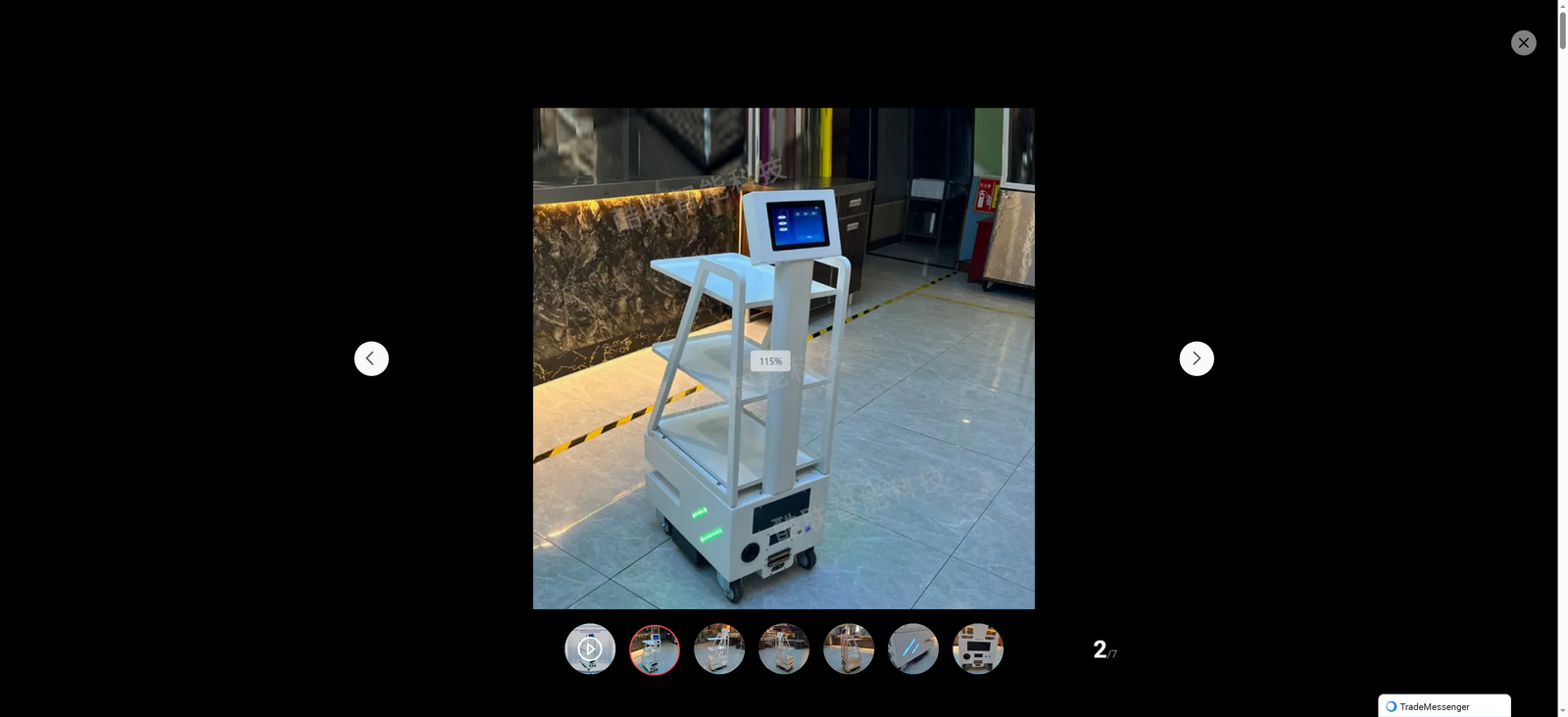
In the wave of Industry 4.0, the transformation of factory warehouse workshops is accelerating, with automatic transportation and delivery robots emerging as core pillars of intelligent logistics. These advanced devices, integrating artificial intelligence, autonomous navigation, and multi-sensor fusion technologies, are breaking the bottlenecks of traditional manual handling, reshaping the material flow patterns of production workshops, and laying a solid foundation for the construction of "dark factories" and "lighthouse factories". From raw material warehousing to finished product distribution, from cross-workshop transfer to intra-line feeding, they are becoming the "smart blood vessels" that drive the efficient operation of manufacturing systems.
Core Technical System: The "Smart Brain" and "Agile Body" of Robots
The stable and efficient operation of automatic transportation and delivery robots relies on a sophisticated technical system, among which autonomous navigation and intelligent scheduling are the core. Unlike traditional AGVs (Automated Guided Vehicles) that rely on magnetic strips or QR codes for fixed-path navigation, modern AMRs (Autonomous Mobile Robots) have achieved a qualitative leap through SLAM (Simultaneous Localization and Mapping) technology. Laser SLAM, with positioning accuracy within ±10mm, is widely used in dynamic automotive manufacturing workshops due to its strong anti-interference ability, although its cost ranges from 150,000 to 300,000 yuan per unit. Visual SLAM, relying on cameras and deep learning algorithms, reduces the cost to 50,000 to 150,000 yuan per unit, making it suitable for scenarios with stable lighting conditions. To further enhance reliability in complex environments, multi-sensor fusion navigation has become the mainstream direction, combining UWB positioning, inertial navigation, and wheel encoders to ensure uninterrupted and accurate operation even in areas with weak signals or dynamic obstacles.
The perception and obstacle avoidance system is the "safety guarantee" for robots to move freely in workshops. A combination of laser radar and depth cameras enables 3D environmental modeling, while ultrasonic sensors cover short-distance blind spots, forming a 360° all-round protection network. The intelligent decision-making layer adopts a two-level control mechanism: the real-time control layer with 100Hz response handles emergency obstacle avoidance, and the task planning layer optimizes delivery paths to respond to sudden orders. Supported by 5G technology with low latency (<1ms) and high bandwidth, multi-robot collaborative scheduling and remote monitoring are realized, achieving seamless connection across the entire factory area. In terms of energy supply, lithium iron phosphate batteries are widely adopted for their safety and environmental protection, and the automatic return-to-charge function ensures 24-hour continuous operation without manual intervention.
Application Value: Transforming Efficiency, Cost, and Flexibility
The popularization of automatic transportation and delivery robots has brought revolutionary changes to factory warehouse workshops, with remarkable performance in efficiency improvement, cost reduction, and safety enhancement. In terms of efficiency, these robots can replace manual handling of high-frequency material transportation tasks between production lines and warehouses, significantly shortening delivery cycles. A new energy vehicle factory has reduced the time for parts transportation from 15 minutes to 5 minutes by deploying 3 robots, and the error rate has dropped from 12% to 1%. Mechanical manufacturing plants have realized cross-floor delivery by equipping robots with elevator control modules, increasing the daily delivery volume by 200 batches. Amazon's Kiva robots have shortened order processing time from 60-75 minutes to 15 minutes, and Geek"s goods-to-person system can dispatch over 1,000 robots to work collaboratively, increasing warehouse throughput by 300%.
In cost control, robots can reduce labor handling costs by more than 80% and minimize goods damage and safety risks caused by human errors. Data from Cainiao Network shows that the efficiency per unit area of smart warehouses using robot solutions is 5 times that of traditional warehouses, and labor costs are reduced by 70%. The flexible deployment feature further lowers the transformation threshold—modern robots can complete map construction by simply traveling along preset routes once, with deployment cycles as short as 1-2 weeks, avoiding large-scale renovation of existing workshops. For small and medium-sized enterprises, the "Robot as a Service" (RaaS) leasing model further reduces the initial investment burden.
Safety and flexibility are another important manifestation of the value of these robots. Equipped with ToF sensors and AI early warning systems, they can achieve precise safety braking within 10cm, eliminating logistics-related safety accidents in workshops. In response to the needs of flexible production, robots can quickly adjust transportation routes and task priorities through the central scheduling system when production orders change, adapting to the multi-variety and small-batch production mode. For example, an automotive electronics enterprise has increased line change efficiency by 40% with the help of robot flexibility.
Industry Application Scenarios: Crossing Boundaries and Integrating into Diversified Production
Automatic transportation and delivery robots have been widely applied in various industries, showing strong scenario adaptability through continuous technical iteration. In the automotive manufacturing industry, Tesla's Gigafactories use AGVs to realize just-in-time delivery of parts, and through digital twin technology, the robots are accurately synchronized with the production line rhythm. In 3C electronics factories, robots with shockproof designs stably transport PCB boards between placement machines, reflow soldering equipment, and testing stations, ensuring the safety of precision components and reducing material loss.
In the medical and cold chain fields, specialized robots with temperature control functions can operate stably in environments of 2-8℃, transporting vaccines and drugs with temperature fluctuation controlled within ±0.5℃. Some models are also equipped with ultraviolet disinfection modules and electronic lock systems to meet the strict requirements of hospital infection control and controlled drug management. In cross-border warehousing and large-scale manufacturing bases, cross-floor AMR systems cooperate with elevator IoT modules to realize unmanned vertical transportation, breaking the spatial limitations of single-floor operation.
For e-commerce logistics warehouses, sorting robots have become the core force for peak order processing. JD.com's Asia No.1 Intelligent Warehouse deploys more than 1,000 sorting robots, handling over one million orders per day with an accuracy rate of 99.99% during the 618 promotion. In heavy industry scenarios such as ports, Zhenhua Heavy Industry's AGVs with a single load capacity of over 40 tons adopt anti-corrosion designs and hydraulic steering systems, realizing 24-hour continuous transportation of containers in high-humidity and high-salt fog environments.
Future Trends: Towards Full-Link Intelligence and Human-Robot Collaboration
With the continuous advancement of technologies such as AI, 5G, and digital twins, automatic transportation and delivery robots are moving towards a new stage of full-link intelligence. The integration of large-model-driven collaborative algorithms will further improve the efficiency of multi-robot scheduling—Kuangshi Technology's "Hetu" system can already dispatch 5,000 devices simultaneously, reducing the collision probability to below 0.001%. The deep integration with WMS (Warehouse Management System) and MES (Manufacturing Execution System) will realize the closed loop of data links, enabling robots to predict material demand through historical data and proactively adjust inventory positions.
Energy technology innovation will further break through the limitations of robot operation. The popularization of fast charging and wireless charging technologies will shorten the charging time, while the application of new battery materials will improve energy density and service life. The development of lightweight and miniaturized robots will expand their application scope to narrow spaces such as precision component workshops, and the open SDK and rich API interfaces will support customized development to meet diversified scenario needs.
The future of automatic transportation and delivery robots is not only about "replacing humans" but also about building a harmonious human-robot collaboration ecosystem. Robots will take over repetitive and heavy handling tasks, allowing employees to shift to positions such as robot operation and maintenance, data analysis, and decision-making. With the continuous expansion of application scenarios and the gradual reduction of costs, these robots will penetrate from head enterprises to small and medium-sized enterprises, becoming a standard configuration for intelligent transformation of factory warehouse workshops and injecting strong momentum into the high-quality development of the manufacturing industry.