
Intelligent Food Delivery Robots: Revolutionizing Catering Services with Automatic Fixed-Point Delivery and Labor Cost Reduction
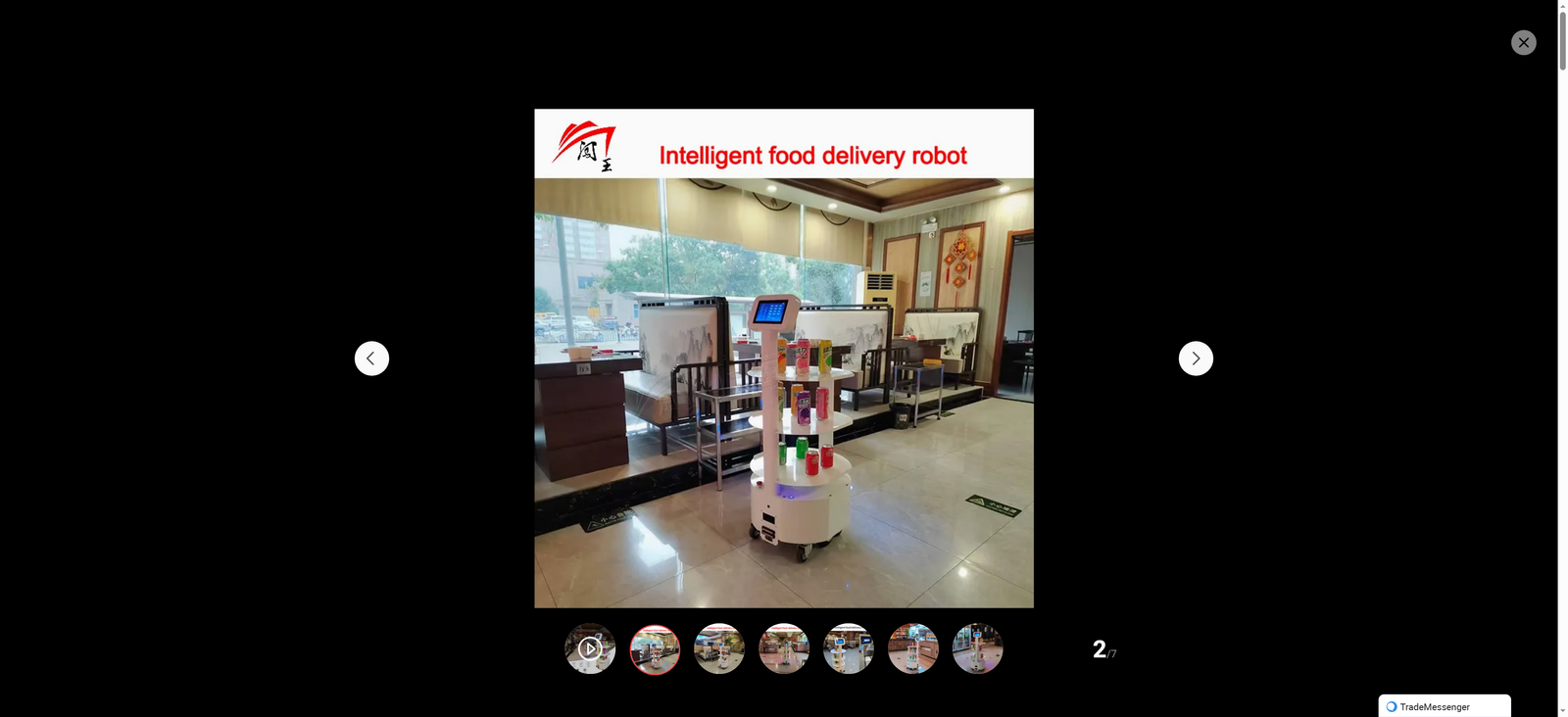
In the ever-evolving catering industry, the "three highs and one low" predicament—high rent, high labor costs, high ingredient costs, and low profit margins—has long plagued operators. Against this backdrop, intelligent food delivery robots have emerged as a transformative solution, leveraging automatic fixed-point delivery technology to break through efficiency bottlenecks and fundamentally optimize labor cost structures. What was once regarded as a novelty has now become a rigid demand for catering businesses pursuing digital upgrading and refined operations.
The core competitiveness of intelligent food delivery robots lies in their precise automatic fixed-point delivery capability, which is built on a sophisticated integration of multiple cutting-edge technologies. At the heart of this capability is the multi-sensor fusion SLAM (Simultaneous Localization and Mapping) navigation system. Unlike traditional single-sensor solutions that struggle with glass partitions, reflective floors, or empty corridors, modern robots combine lidar, depth cameras, inertial measurement units (IMU), and odometers to construct high-precision environmental maps. This fusion enables centimeter-level positioning accuracy, ensuring robots can stably dock at designated tables or rooms without getting lost or drifting, even in crowded and dynamically changing spaces like restaurants and hotels.
Complementing advanced navigation is predictive obstacle avoidance and dynamic path planning technology. Restaurants and catering venues are typical unstructured dynamic environments, with waiters shuttling and customers moving unexpectedly. Intelligent food delivery robots go beyond passive obstacle avoidance; they use spatiotemporal joint planning algorithms to predict pedestrians' movement trajectories in the next few seconds, making detour or deceleration decisions 0.5 seconds in advance. In multi-robot collaboration scenarios, a decentralized scheduling system allows dozens of robots to negotiate right-of-way independently, avoiding congestion and ensuring smooth operation during peak hours. For fixed-point delivery, this means consistent efficiency—robots can complete deliveries in 5 minutes or less per trip, far outperforming manual services.
The value of these technological advantages is most directly reflected in significant labor cost reduction. Data shows that manual delivery staff can complete approximately 200 orders per day, while mature intelligent food delivery robots can handle 400 to 600 orders, doubling or tripling work efficiency. In terms of unit cost, the average cost per robot delivery is only 1.2 yuan (including depreciation, power consumption, and maintenance), which is much lower than the 5.8 yuan per manual delivery. A medium-sized catering brand in China reported a 60% reduction in front-end service labor costs after deploying robots, with the investment payback period shortened to 1.8 years thanks to reduced staffing needs and operational efficiency improvements.
The application scenarios of intelligent food delivery robots continue to expand, bringing cost-saving benefits to various catering and service industries. In restaurants and fast-food chains, robots take over repetitive delivery tasks during peak hours, allowing human staff to focus on high-value services such as customer consultation and dish introduction, improving overall service quality. In hotels, robots provide 24-hour room service delivery, eliminating the need for late-night room service staff and reducing labor costs while enhancing guest experience with on-demand convenience. Campus canteens and hospitals also benefit from fixed-point delivery—robots transport meals to designated areas, reducing queuing time for students and ensuring timely meal delivery for patients without additional human input.
The evolution of intelligent food delivery robots is not limited to basic delivery functions. With the integration of large language models (LLMs), modern robots have upgraded from "delivery tools" to "intelligent service partners." Equipped with self-developed large models, robots can engage in multi-round natural language conversations, answer customer questions about dishes, ingredients, and promotions, and even provide personalized marketing recommendations during idle periods. Some high-end models also feature tray-mounted cameras for automatic meal recognition and pickup detection, enabling "contactless confirmation"—robots automatically leave after customers pick up meals without manual operation, while digitizing delivery accuracy for operational analysis.
The global intelligent food delivery robot market is experiencing rapid growth, driven by increasing labor costs and technological maturity. In 2024, the global market size exceeded 5 billion US dollars, and it is expected to reach 18 billion US dollars by 2030, with a compound annual growth rate of over 25%. In China, the shipment volume of catering service robots is projected to exceed 150,000 units in 2025, with policy support further boosting industry development—many regions offer subsidies of 5,000 to 8,000 yuan per robot, reducing enterprise procurement costs by up to 18%.
While challenges such as inconsistent industry standards and limited adaptability to extreme environments remain, intelligent food delivery robots have undoubtedly become a key driver of the catering industry's transformation. By combining automatic fixed-point delivery with labor cost reduction, they not only solve the immediate operational pain points of catering businesses but also lay the foundation for digital and intelligent upgrading. As technology continues to iterate and business models innovate, these robots will play an increasingly important role in reshaping the catering service landscape, balancing efficiency, cost, and customer experience in a way that traditional manual services never could.