
Multi-Functional Catering and Hotel Customized Commercial Service Delivery Robot: Leading a New Era of Intelligent Service
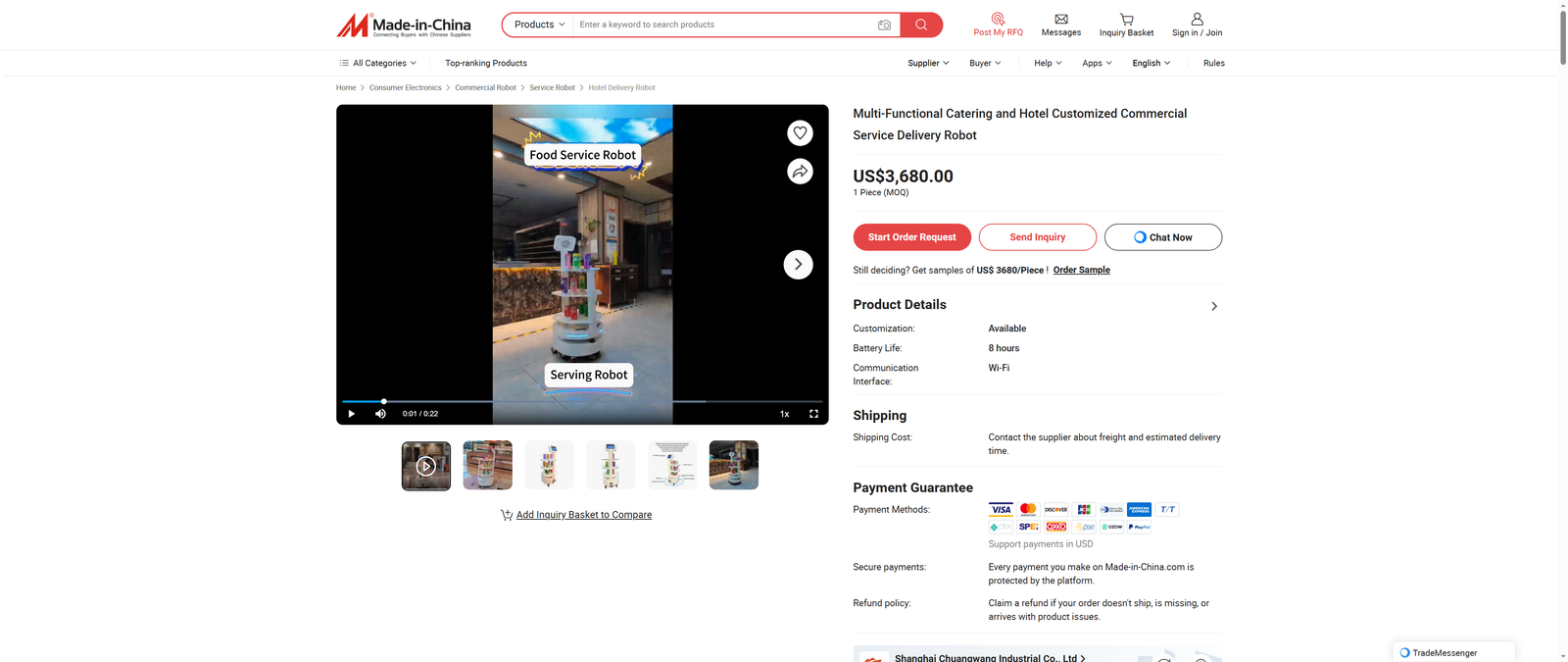
With the rapid development of artificial intelligence, Internet of Things and automation technology, the service industry is undergoing a profound transformation. Among them, the multi-functional catering and hotel customized commercial service delivery robot, as a key carrier of intelligent upgrading, has gradually stepped out of the technical laboratory and entered thousands of catering and hotel scenes. It breaks the limitations of traditional manual service, integrates multiple functions such as delivery, guidance, reception and information release, and creates a more efficient, standardized and humanized service experience for the commercial service field. This article will deeply explore the core value, application characteristics and development prospects of this type of intelligent robot, and interpret how it is reshaping the new pattern of the catering and hotel industry.
The multi-functional catering and hotel customized commercial service delivery robot is not a simple "automated cart", but a highly integrated intelligent service terminal customized for the specific needs of the catering and hotel industries. Unlike ordinary industrial robots, it pays more attention to adaptability to complex human environments, interaction with customers, and compatibility with existing service processes. For catering scenarios, it can accurately complete meal delivery, dish retrieval, table cleaning reminders and other tasks; for hotel scenarios, it can undertake room service delivery, guest guidance, check-in information notification and other services. What is more important is that its "customized" attribute enables it to be tailored according to the scale, layout and service characteristics of different businesses - for small and medium-sized restaurants with narrow spaces, it can be designed as a compact model with flexible turning; for high-end hotels pursuing quality service, it can be equipped with a high-definition touch screen, voice interaction system and high-end appearance design to match the brand positioning.
Efficiency improvement and cost optimization are the most direct values brought by multi-functional service delivery robots to catering and hotel businesses. In the catering industry, especially during peak meal hours, the shortage of waiters, long meal delivery time and easy order errors have always been pain points for operators. The delivery robot can realize 24-hour continuous work without fatigue, and through the pre-set map navigation and obstacle avoidance system, it can accurately reach the designated table in the shortest time, reducing the meal delivery time by more than 30% compared with manual work. At the same time, it can synchronize the order information with the restaurant's POS system, avoiding order errors caused by manual communication. For hotels, the robot can replace manual work to complete a large number of repetitive tasks such as delivering mineral water, towels and other daily necessities to guest rooms, which not only reduces the workload of housekeeping and service staff, but also shortens the response time of guest requests. In the long run, although the initial investment of robots exists, it can significantly reduce the labor cost, training cost and management cost of enterprises, and bring stable return on investment for businesses.
Beyond efficiency and cost, multi-functional service delivery robots also bring a qualitative leap in service quality and customer experience. In the era of consumption upgrading, customers' demand for catering and hotel services is no longer limited to "basic satisfaction", but more pursuit of personalization, interaction and sense of technology. The robot's standardized service can ensure that every customer receives consistent service quality - it will not be perfunctory due to fatigue, nor will it make mistakes due to negligence, which effectively improves the service standardization of businesses. At the same time, the intelligent interaction function of the robot has become a new "highlight" of service. Equipped with advanced voice recognition and natural language processing technology, it can answer customers' common questions, such as "what signature dishes are there in the restaurant", "where is the hotel's fitness center" and so on, and can even carry out simple emotional communication, bringing a fresh and interesting experience to customers. For high-end hotels, the robot can also provide customized services according to guest information, such as greeting guests by name when they check in, and delivering customized welcome gifts to the room, which greatly enhances the sense of identity and satisfaction of guests.
The stable operation and safe service of multi-functional service delivery robots rely on the strong support of core technologies. Among them, autonomous navigation and obstacle avoidance technology is the "core capability" of the robot - relying on laser radar, visual sensors and SLAM algorithm, the robot can quickly build a scene map, realize real-time path planning, and flexibly avoid obstacles such as pedestrians, tables and chairs in complex environments, ensuring the safety and efficiency of delivery. The Internet of Things and cloud management platform enable the robot to realize remote monitoring, task scheduling and data statistics. Operators can check the working status, task completion rate and fault information of the robot through the background system, and carry out centralized management and maintenance, which improves the management efficiency of the robot. In addition, the improvement of battery life technology and structural design also provides a guarantee for the long-term stable operation of the robot. At present, most commercial service delivery robots can work continuously for 8-12 hours after a single charge, and support fast charging, which fully meets the needs of daily business operations.
Of course, the popularization and application of multi-functional catering and hotel customized commercial service delivery robots also face certain challenges. On the one hand, the initial investment cost is relatively high, which may bring certain financial pressure to small and medium-sized businesses; on the other hand, some elderly customers may have a sense of distance from intelligent robots and prefer manual service; in addition, the adaptability of robots to extreme scenarios (such as crowded peak hours, complex terrain) still needs to be further improved. However, with the continuous progress of technology and the expansion of market scale, the cost of robots is gradually reducing, and the function and experience are constantly optimizing. More and more businesses begin to realize the value of intelligent robots, and the penetration rate in the catering and hotel industries is increasing year by year.
Looking to the future, the multi-functional catering and hotel customized commercial service delivery robot will move towards a more intelligent, humanized and integrated direction. With the development of 5G, big data and artificial intelligence technology, the robot will have stronger learning ability and scene adaptation ability - it can analyze customer consumption habits through big data, provide personalized service recommendations; it can cooperate with other intelligent devices in the store (such as intelligent cash registers, intelligent refrigerators) to realize the whole process of intelligent service. At the same time, the integration of robot technology and green and low-carbon concepts will also become a new trend. More energy-saving and environment-friendly robot products will be launched to help the service industry achieve green development. In addition, the application scenario of the robot will also be further expanded, from catering and hotels to airports, stations, shopping malls and other more commercial service fields, becoming an important part of the intelligent service ecosystem.
In conclusion, the multi-functional catering and hotel customized commercial service delivery robot is not only a product of technological progress, but also a inevitable choice for the intelligent upgrading of the service industry. It takes efficiency as the foundation, quality as the core, and customization as the characteristic, which not only solves the practical pain points of catering and hotel businesses, but also meets the new needs of consumers for intelligent services. With the continuous breakthrough of technology and the continuous maturity of the market, this type of robot will surely play a more important role in the catering and hotel industry, leading the service industry into a new era of intelligence, efficiency and high quality. For businesses, seizing the opportunity of intelligent robot application will become a key factor to enhance core competitiveness in the fierce market competition.