
Lidar Navigation Food Robot: Redefining Dining Service with Obstacle Avoidance and Multi-Table Delivery
In the fast-paced world of food and beverage service, efficiency, accuracy, and customer experience are the cornerstones of success. As restaurants, cafes, and catering venues strive to streamline operations, reduce labor burdens, and elevate guest satisfaction, intelligent food delivery robots have emerged as game-changing solutions. Among these innovations, lidar navigation food robots stand out, leveraging cutting-edge technology to master two critical capabilities—reliable obstacle avoidance and efficient multi-table delivery—thus transforming the way food is served and enhancing the overall dining ecosystem.
At the heart of these advanced food delivery robots lies lidar (Light Detection and Ranging) navigation, a technology that has revolutionized autonomous movement in complex indoor environments. Unlike traditional navigation systems that rely on pre-installed markers, QR codes, or limited camera vision, lidar navigation uses laser pulses to scan the surrounding environment in real time, creating a high-precision 3D map of the space3. This allows the robot to perceive its surroundings with centimeter-level accuracy, identify fixed structures such as tables, chairs, and walls, and adapt to dynamic changes—whether it’s a server moving between tables, a child running nearby, or a temporary obstacle like a misplaced tray2. The lidar sensor, often mounted on the top of the robot, operates with an impressive detection range (up to 25 meters in some models) and 360-degree coverage, ensuring no blind spots and enabling continuous, uninterrupted navigation2. This level of precision eliminates the risk of collisions, reduces service disruptions, and ensures the robot can navigate even the busiest dining floors with ease, making it a reliable addition to high-traffic venues.
Complementing lidar navigation is the robot’s intelligent obstacle avoidance system, a critical feature that ensures safety and efficiency in dynamic dining environments. The obstacle avoidance capability is powered by a fusion of lidar data, ultrasonic sensors, and advanced AI algorithms, working in tandem to detect, classify, and respond to obstacles in milliseconds7. When an obstacle is detected—whether it’s a moving person, a stationary object, or even a small item like a dropped napkin—the robot does not merely stop; it dynamically adjusts its path, either slowing down to navigate around the obstacle or pausing temporarily until the path is clear8. This seamless response is particularly valuable during peak dining hours, when restaurants are crowded and the risk of obstacles is highest. Unlike manual delivery, which is prone to human error and delays caused by navigating through crowds, these robots maintain a steady pace, ensuring food is delivered hot, fresh, and on time while minimizing the risk of spills or accidents4. For fragile items like soups, desserts, or beverages, the robot’s stable chassis (often equipped with independent suspension) further enhances obstacle avoidance performance, keeping the payload secure even when adjusting paths4.
Another key advantage of lidar navigation food robots is their multi-table delivery capability, a feature designed to maximize efficiency and reduce the number of trips required to serve multiple guests. In traditional dining settings, servers often need to make multiple trips between the kitchen and dining area to deliver food to different tables, wasting time and energy that could be spent on enhancing customer interaction4. With multi-table delivery, a single lidar navigation food robot can carry multiple orders (up to three or more tables in one trip, depending on the model) using multi-layered, detachable trays, each capable of holding a significant payload26. The robot’s lidar navigation system allows it to plan the optimal route to visit all designated tables in sequence, avoiding backtracking and minimizing delivery time7. For example, during a busy lunch rush, a robot can pick up orders for tables 5, 8, and 12 from the kitchen, navigate directly to each table in the most efficient order, and alert guests with voice prompts or screen notifications when their food is ready26. This not only reduces the workload for servers but also speeds up service, shortens guest wait times, and increases table turnover—all of which contribute to higher revenue for the venue4.
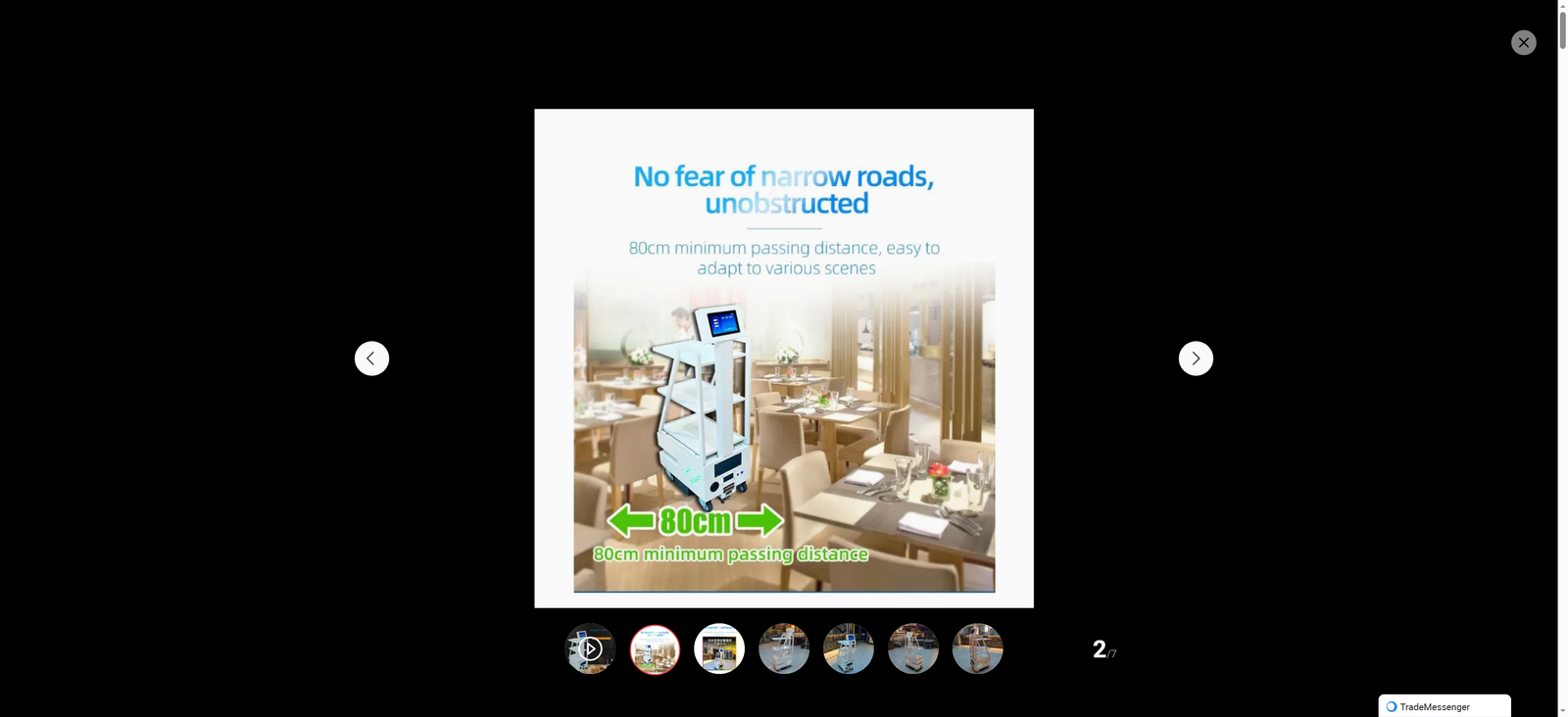
The synergy of lidar navigation, intelligent obstacle avoidance, and multi-table delivery makes these food robots a versatile solution for a wide range of food service environments. From casual cafes and fast-food restaurants to high-end dining venues, hotels, and even hospitals or corporate cafeterias, these robots adapt seamlessly to different space layouts and service demands68. For example, in a crowded hot pot restaurant with narrow aisles, the robot’s lidar navigation and obstacle avoidance capabilities ensure it can navigate between tightly packed tables without collisions, while its multi-table delivery feature reduces the number of trips needed to serve multiple tables5. In a hotel cafeteria, the robot can deliver meals to multiple guest tables or rooms efficiently, freeing up staff to focus on other guest needs6. Additionally, many models offer extra features that enhance their value, such as automatic charging (returning to the dock when battery is low), interactive screens for promotions, and multi-robot coordination to avoid congestion during peak hours26.
Beyond operational efficiency, lidar navigation food robots also enhance the customer experience in meaningful ways. The novelty of interacting with an intelligent robot adds a futuristic, fun element to the dining experience, attracting tech-savvy customers and families1. Guests no longer need to wait anxiously for their food; instead, they can watch the robot navigate smoothly through the dining area, adding a unique form of entertainment. The robots also ensure consistency in service—delivering food with the same speed and care every time—reducing the risk of human error such as missed orders or incorrect table deliveries7. Furthermore, by reducing the need for servers to spend time on repetitive delivery tasks, staff can focus on more personalized interactions with guests, such as explaining menu items, addressing special requests, or providing recommendations—all of which foster customer loyalty and positive word-of-mouth14.
As the food service industry continues to evolve, lidar navigation food robots are poised to become an indispensable tool for businesses looking to stay competitive. Their ability to combine precise lidar navigation, reliable obstacle avoidance, and efficient multi-table delivery addresses key pain points in the industry—labor shortages, slow service, and high operational costs—while enhancing the overall dining experience45. With ongoing advancements in AI and sensor technology, these robots will only become more intelligent, adaptable, and cost-effective, capable of handling even more complex tasks such as dish retrieval, promotional displays, or even personalized greetings with face recognition15.
In conclusion, lidar navigation food robots are transforming the food service landscape by redefining how food is delivered. Their core capabilities—lidar navigation for precision, obstacle avoidance for safety, and multi-table delivery for efficiency—work together to streamline operations, reduce labor burdens, and elevate guest satisfaction. For restaurants and food service venues looking to embrace innovation, improve efficiency, and stand out in a crowded market, investing in a lidar navigation food robot with obstacle avoidance and multi-table delivery capabilities is not just a trend—it’s a strategic decision that delivers long-term value.