
400 Kg Heavy Duty Pallet Transport AGV: Industrial Grade LiDAR Drives Warehouse Automation Revolution
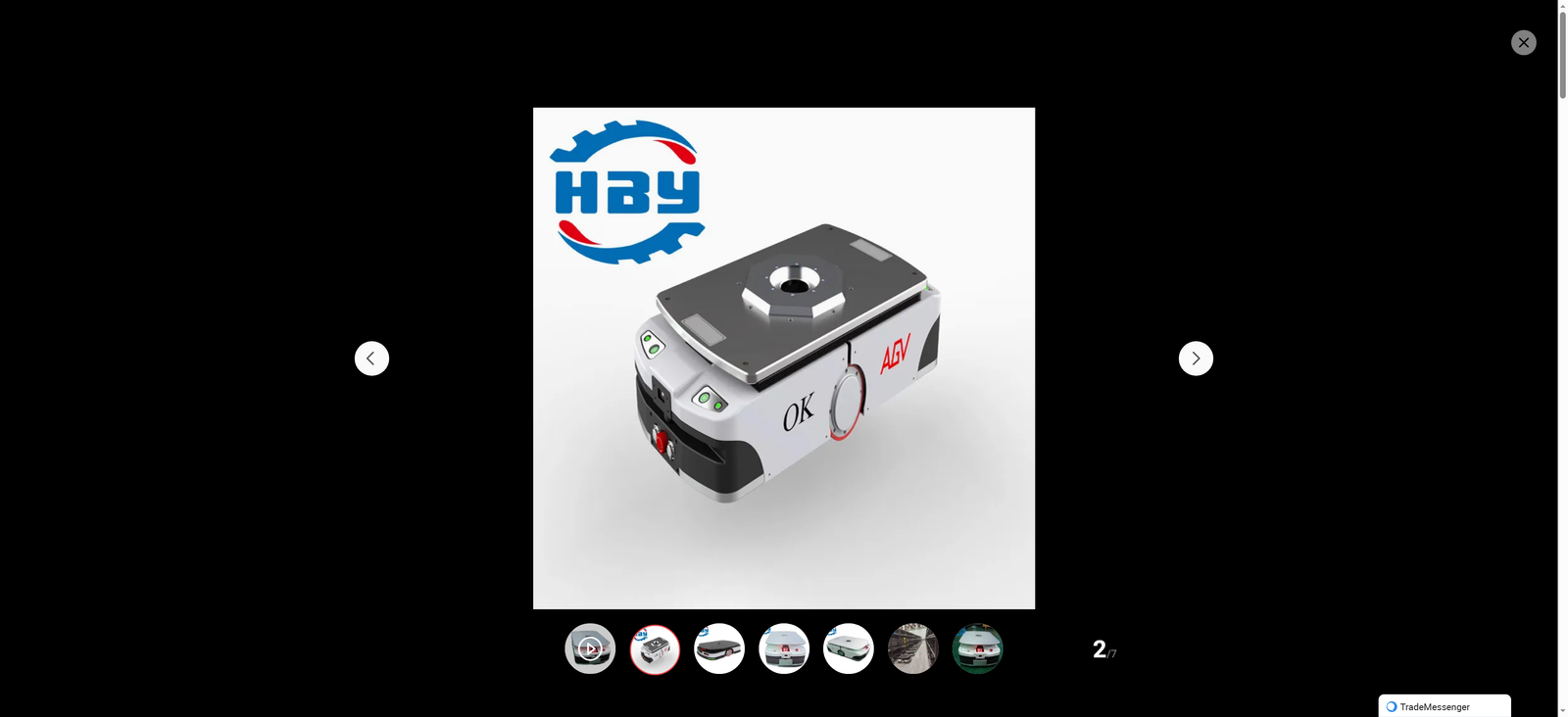
In the era of intelligent manufacturing, warehouse logistics automation has become a core competitiveness for enterprises to improve efficiency, reduce costs and enhance market adaptability. Among numerous automated handling equipment, the 400 Kg Heavy Duty Pallet Transport AGV (Automated Guided Vehicle) equipped with industrial-grade LiDAR (Light Detection and Ranging) stands out, becoming a key link in optimizing pallet handling processes and realizing seamless connection of warehouse operations. This industrial-grade intelligent robot integrates advanced navigation technology, heavy-duty carrying capacity and flexible operation performance, breaking through the bottlenecks of traditional manual handling and semi-automated transportation, and injecting strong momentum into the transformation and upgrading of modern warehouses.
The 400 Kg Heavy Duty Pallet Transport AGV is specially designed for medium-heavy load pallet transportation scenarios in industrial warehouses, with its core performance focusing on stability, precision and efficiency—three key requirements of industrial-grade applications. Unlike light-duty AGVs that are only suitable for small-package handling, this type of AGV adopts a reinforced body structure, high-load-bearing driving wheels and a stable lifting platform, which can stably carry pallets with a maximum weight of 400 kg, covering the majority of palletized goods transportation needs in manufacturing workshops, logistics warehouses, cold storage and other scenarios. Whether it is raw material feeding, semi-finished product transfer or finished product warehousing, it can complete the handling task independently, avoiding the damage to goods and pallets caused by manual handling fatigue and misoperation, and effectively improving the integrity rate of goods during transportation.
The core driving force behind the intelligent operation of this AGV lies in the industrial-grade LiDAR navigation system, which is the "eyes" and "brain" of the robot and determines its adaptability and operation precision in complex warehouse environments. Different from ordinary consumer-grade LiDAR, industrial-grade LiDAR has the characteristics of high stability, strong anti-interference ability and high measurement precision, which can work stably for a long time in harsh industrial environments such as dust, noise and changing light intensity—the common challenges in warehouses and workshops. Its working principle is to emit laser beams at high frequency, receive the reflected signals from surrounding objects, calculate the distance and position of obstacles and environmental features through the time difference between emission and reception, and then construct a real-time 3D environmental map by combining SLAM (Simultaneous Localization and Mapping) technology. On this basis, the AGV can realize autonomous positioning with a precision of ±10mm/±1°, dynamically plan the optimal transportation path, and flexibly avoid obstacles such as personnel, shelves and other equipment during operation, ensuring safe and efficient operation without manual intervention.
In addition to the core advantages of heavy-duty carrying and high-precision LiDAR navigation, the 400 Kg Heavy Duty Pallet Transport AGV also integrates a variety of industrial-grade intelligent functions to adapt to the complex and changeable needs of warehouse automation. It supports two-way forward and backward driving, which greatly improves the mobility in narrow warehouse channels and avoids the trouble of turning around in limited spaces, making full use of the warehouse space. The equipped intelligent control system can realize seamless connection with warehouse management systems (WMS), manufacturing execution systems (MES) and other third-party facilities, realizing unified scheduling of multiple AGVs, task assignment and real-time data monitoring. For example, when the WMS system issues a pallet transportation task, the AGV can automatically receive the task, plan the path, go to the designated location to lift the pallet, and transport it to the target position accurately, and feed back the task completion status to the management system in real time, forming a closed-loop management of the whole transportation process. At the same time, it is equipped with multiple safety protection measures, including anti-collision strips, emergency stop buttons and depth cameras, which can immediately stop operation when encountering obstacles or emergencies, ensuring the safety of personnel, equipment and goods in the warehouse.
The application of 400 Kg Heavy Duty Pallet Transport AGV with industrial-grade LiDAR has brought revolutionary changes to warehouse operation and management, and its practical value is reflected in multiple dimensions. From the perspective of efficiency improvement, the AGV can operate continuously for more than 8 hours, with a full-load maximum speed of up to 1.2m/s, which is 3-5 times that of manual handling. It can avoid the idle time caused by manual rest, meal time and other factors, and greatly improve the efficiency of pallet transportation, especially in large-scale warehouses with frequent pallet handling, which can effectively reduce the backlog of goods and improve the turnover efficiency of the warehouse. From the perspective of cost control, it can replace a large number of manual handlers, reducing the labor cost which is increasing year by year—for enterprises, the investment in AGVs can usually be recovered within 1.5 to 2 years, and the later maintenance cost is only 1/3 of that of traditional internal combustion handling equipment. In addition, the AGV does not need fixed tracks, which can increase the effective use area of the warehouse by 15-20%, and further reduce the operating cost of the warehouse by optimizing the space layout.
In the context of the global promotion of intelligent manufacturing and the continuous upgrading of warehouse logistics, the market demand for 400 Kg Heavy Duty Pallet Transport AGV is showing a rapid growth trend. It is widely used in automobile manufacturing, electronics, food and beverage, logistics and distribution and other industries, becoming an indispensable core equipment in modern intelligent warehouses. For example, in the automobile manufacturing industry, it can be used to transport auto parts pallets between workshops; in the logistics and distribution industry, it can realize the automatic transfer of pallets between the receiving area, storage area and shipping area; in the food and beverage industry, it can complete the transportation of raw material pallets and finished product pallets, avoiding cross-contamination caused by manual contact. With the continuous iteration of LiDAR technology, the performance of this type of AGV is also constantly upgrading—such as the improvement of navigation precision, the optimization of battery life (charging time ≤1.5h, supporting fast charging), and the enrichment of intelligent functions, which will further expand its application scenarios and bring more possibilities for the automation and intelligence of the warehouse industry.
Looking to the future, with the in-depth integration of industrial-grade LiDAR, 5G, artificial intelligence, digital twin and other technologies, the 400 Kg Heavy Duty Pallet Transport AGV will move towards a more intelligent, flexible and integrated direction. It will not only realize more precise path planning and more flexible obstacle avoidance, but also realize collaborative operation with other intelligent equipment such as robotic arms and automatic stackers, forming a full-process automated warehouse handling system from goods receiving, storage, handling to shipping. At the same time, with the support of digital twin technology, the operation status of AGVs can be simulated in real time, realizing fault prediction and preventive maintenance, reducing the failure rate and ensuring the stable operation of the warehouse logistics system. As an important carrier of warehouse automation, it will help more enterprises break through the bottlenecks of traditional logistics, realize the transformation from "labor-intensive" to "technology-intensive", and promote the high-quality development of the global warehouse logistics industry.